
Broken Torsion Springs
Broken torsion springs on double doors lead the list. It tracks with how many houses here were built in the 1980s and 90s with two-car garages and standard torsion setups.
Local garage door service · Leesburg, VA
Leesburg, VA garage door repair and installation for 1938-2015 homes, with spring, roller, and opener service built for harsh cold-season swings.
Garage door services
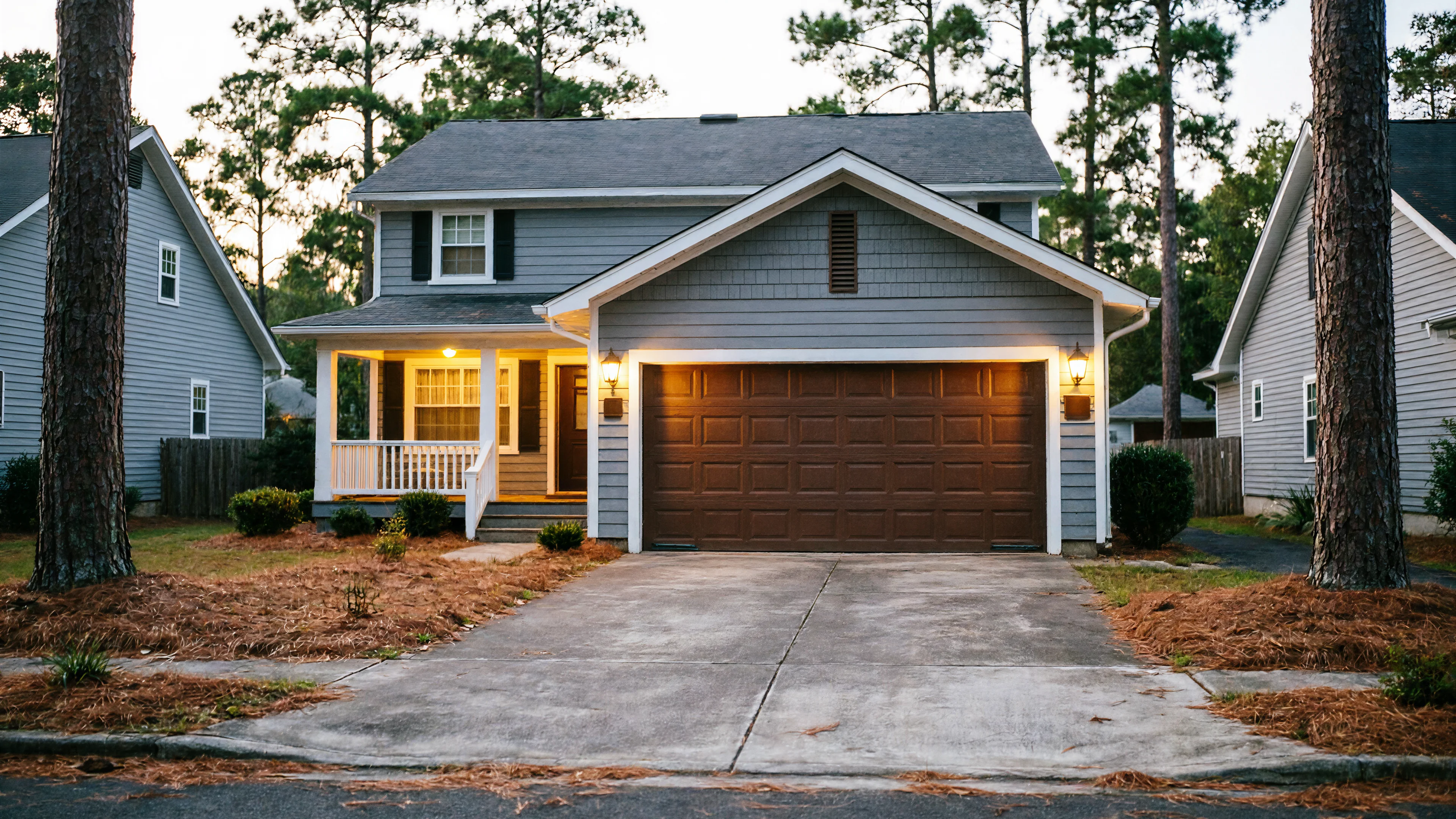
From emergency repair and spring work to opener repair, roller replacement, maintenance, general service, and new door installation, the lineup is built around Leesburg's 1938-2015 housing stock and the 1980s-90s torsion hardware common across Loudoun County.


Common Leesburg garage door problems
Broken torsion springs on double doors are the single most common call, which tracks with how many houses here were built in the 1980s and 90s with two-car garages and standard torsion setups. Second most common is worn rollers and track misalignment, usually from years of a door running without lubrication. On the older housing stock - anything pushing toward the 1938 end of the range - we see more cable and drum issues, along with openers that are well past their reasonable service life. Extension spring systems, which were more common before torsion became standard, show up less often now but still turn up in untouched original garages. What we don't do much with is fully custom architectural doors - carriage-style or heavy wood units - since those usually need a specialty installer, and we'll tell you that straight rather than take the job and guess.
Broken torsion springs on double doors lead the list. It tracks with how many houses here were built in the 1980s and 90s with two-car garages and standard torsion setups.
Worn rollers and track misalignment are the second most common call, usually from years of a door running without lubrication and dragging in the cold.
On the older stock pushing toward the 1938 end of the range, we see more cable and drum issues than on newer doors, often alongside hardware that has gone untouched for decades.
Openers that are well past their reasonable service life turn up often on older homes, where the drive system has outlasted its design life and keeps failing.
Extension spring systems were more common before torsion became standard. They show up less often now but still turn up in untouched original garages near town.
Clear repair guidance
We don't quote a flat number over the phone because the job isn't the same on every street. A torsion spring replacement on a door installed when a house was built in the 1990s is a different job than fixing hardware on something from the late 1930s original stock near the older part of town.
Door size, spring count, whether the opener is original or already replaced once, and how long parts have sat unmaintained all change the bill. What we can tell you is what we look at before we give you a number: the age and type of door, the condition of the track and rollers, whether the springs match the door weight, and whether the opener is still under any coverage.
In a service area where median household income runs well above $176,000, we still see the same failure patterns as anywhere else - age and neglect, not neighborhood, drive most of the repair cost. Cold-weather wear adds to it, since steel springs near the end of their life tend to let go in January rather than July.
We'll walk you through what's actually broken, what's wearing out but still working, and what can wait. You decide. We're not going to sell you a full door replacement when a spring and a tune-up will get you another decade.
Local housing matters
Houses in this part of Loudoun County were built anywhere from 1938 to 2015, with the median landing around 1986 - meaning most of what we touch is 1980s and 90s construction across roughly thirteen named subdivisions and areas we work in regularly.
That means a lot of double-wide steel doors on extension spring systems, torsion conversions done somewhere along the way, and openers that have already been swapped once by a previous owner. Hardware standards shifted a lot over that stretch, so two houses on the same street can need very different parts.
Older sections closer to town carry a different problem set: original single doors, smaller headroom, and hardware you can't just order off a shelf anymore. We carry parts for both eras, but the older stuff sometimes means a special order rather than a same-visit fix.
The bulk of our calls come from the denser 1980s-90s pockets closer in, where roughly 21,877 owner-occupied houses sit among about 36,086 households total - so the two-car torsion door is what we see most, with the original in-town stock turning up as the harder, parts-dependent jobs.

Cold-weather garage door wear
This area sits in a severe cold climate band, so a door that's already marginal tends to show it hardest in January, when steel contracts, lubricant thickens, and a spring that was already worn finally lets go. Cold doesn't create the problem on its own - it exposes spring fatigue, roller and track resistance, and tired openers that were close to failing anyway.
Leesburg sits in a climate zone rated severe cold. Repeated winter swings put more stress on aging hardware than a milder region would, so marginal parts fail sooner here.
Steel springs lose some flexibility as temperatures drop. A spring that's already near the end of its life tends to fail in January rather than July, so a slow door in fall is worth checking.
In deep cold, lubricant thickens and adds drag, so an older door that was moving fine in warm weather starts travelling slowly and working the opener harder.
When steel contracts in the cold, worn rollers and marginal track alignment become more noticeable, and a door that was quietly declining starts grinding and jumping the track.
What to expect
We come out, open and close the door a few times, and listen before touching anything; from there we check the full system, look harder at older framing near the historic parts of town, and give you a diagnosis and a number before the repair starts, not after.
We open and close the door a few times and listen before we touch anything. Noise, speed, and how it sits when half-open tell us most of what's wrong before a tool comes out.
From there we check spring tension, cable condition, track alignment, and the opener's force settings - a door that won't close is sometimes a broken spring and sometimes a misaligned safety sensor, and those are not the same job.
On the older, pre-1980s doors closer to the historic parts of town, we also check whether the header and jamb have shifted, which is common in houses built before modern framing standards tightened up.
We give you the diagnosis and a number before we start the repair, not after. You decide what gets done that visit and what can wait.
Older Doors May Need Ordered Parts
If parts need ordering - which happens more with older hardware than with 1990s-era doors - we tell you that up front instead of leaving the door half-apart, and give you a realistic timeline before starting.
Repair or replace?
A broken spring, cable, or opener component doesn't automatically mean the whole door needs replacing. But sometimes the honest answer is to replace, not repair - when the panel is rusted through, the frame is rotted, the opener has already failed twice, or several symptoms are stacking up going into another winter.
If the door is a single-layer steel panel from the 1980s with rusted-through bottom sections, putting new springs on it is throwing money at something that will fail again in a different spot within a year.
Rotted wood trim around the frame undermines how the door seals and seats, so a repair to the hardware alone doesn't fix the real problem and won't hold through another season.
An opener that's already failed twice is telling you something. At that point, a third repair rarely makes sense against the cost of a unit that will actually last.
We won't try to retrofit modern safety sensors onto some older track systems where the geometry just doesn't support it properly. That's a replacement conversation, not a repair one.
If a door already shows slow travel, grinding, and gaps at the bottom, going into another winter on a patch job usually costs more than doing it right once.
1930s-2010s garage door systems
Leesburg's broad 1938-2015 build range means garages can combine double-wide steel doors on extension springs, torsion conversions done partway through a door's life, newer standard torsion setups, and openers already swapped once by a previous owner - plus original single doors on the older in-town streets.
The 1980s-90s pockets are full of double-wide steel doors built for two-car garages. These are the standard torsion jobs we see most often across the newer subdivisions.
Many of those double doors went in on extension spring systems, which were common before torsion became standard and behave differently when they wear or snap.
Plenty of doors here have had torsion conversions done somewhere along the way, so the spring system installed now may not match how the door was originally built.
Openers have usually been swapped at least once by a previous owner, so a newer opener often runs on an older door whose hardware it doesn't perfectly match.
Older sections closer to town carry original single doors with smaller headroom and hardware you can't just order off a shelf anymore.
Built around Leesburg garage doors
With extension-spring doubles, mid-life torsion conversions, and original in-town single doors all in play, and openers swapped at different times, the visible door, spring system, opener, and tracks may all be from different eras - so we inspect before matching parts and carry stock for both ends of the range.
Door size and type, spring count, track and roller condition, whether the springs match the door weight, and the opener's age are all checked directly before anything is ordered.
A conversion done partway through a door's life means the spring system installed now may not match the original build, so we confirm what's actually on the door first.
We stock parts for the 1980s-90s standard doors and the older in-town hardware, though the oldest stuff sometimes means a special order rather than a same-visit fix.
When hardware is old enough that you can't order it off a shelf anymore, we say so up front and give a realistic timeline instead of leaving the door half-apart.
Service areas
We're based in Leesburg and the bulk of our calls come from the denser 1980s-90s pockets closer in, but we run trucks across the surrounding Loudoun County towns rather than keeping a storefront in each one. Within reach we regularly cover Waterford, Purcellville, Brambleton, Aldie, Round Hill, Arcola, Lovettsville, Middleburg, South Riding, Great Falls, Bull Run, Wolf Trap, and Upperville - a mix of newer subdivision stock and older in-town streets, each with its own hardware quirks.
The closer you are to Leesburg, the easier same-day scheduling is to land. The farther out we drive, the more we batch the route with a nearby call, so a little flexibility on timing helps us get to you faster. Wherever you are in that list, the diagnosis is the same: we look at the door, tell you what's actually broken, and quote the repair before we start it.
From our Leesburg, VA base we run trucks across the surrounding towns rather than keeping a storefront in each one. These are the areas we serve most often - pick yours to see the local detail.
Questions
Yes, though parts for that era often need to be special-ordered rather than pulled off a shelf. We'll tell you upfront if a part isn't something we stock, and give you a realistic timeline before starting the job.
This area sits in a severe cold climate band, and steel springs lose some flexibility as temperatures drop. A spring that's already near the end of its life tends to fail in winter rather than summer, so a slow or noisy door in fall is worth checking before it gets cold.
Yes, we cover the surrounding area including Waterford, Purcellville, Brambleton, Aldie, Round Hill, Arcola, Lovettsville, Middleburg, South Riding, Great Falls, Bull Run, Wolf Trap, and Upperville.
No. We tell you what's actually broken and what's still fine. If a spring and a tune-up solve the problem, that's what we do. We only recommend full replacement when the door or opener is genuinely past the point of a reasonable fix.
Ready when you are
Tell us what the door is doing and we'll help you sort out the fix in Leesburg.